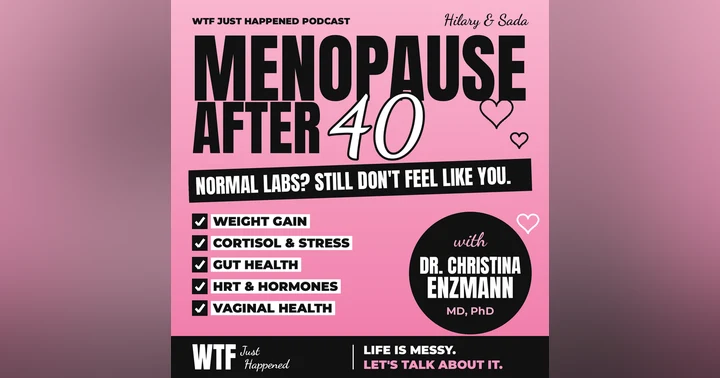
Menopause in Midlife: Hormones, Weight & HRT | Dr. Christina Enzmann


If you’ve been told your labs are “normal” but you don’t feel like yourself — this episode is for you. We sat down with Dr. Christina Enzmann, MD, PhD, board-certified gynecologist and certified menopause specialist, who merges evidence-based conventional medicine with functional medicine. She went through perimenopause herself at 45 and became the doctor she wished she’d had. In this episode we cover: Why menopause is actually a neuroendocrine and metabolic event — not just ...


If you’ve been told your labs are “normal” but you don’t feel like yourself — this episode is for you.
We sat down with Dr. Christina Enzmann, MD, PhD, board-certified gynecologist and certified menopause specialist, who merges evidence-based conventional medicine with functional medicine. She went through perimenopause herself at 45 and became the doctor she wished she’d had.
In this episode we cover:
- Why menopause is actually a neuroendocrine and metabolic event — not just a hormonal one
- The real reason you’re gaining weight in your midsection (and why cutting calories and exercising harder is making it WORSE)
- How estrogen loss affects your gut — and why so many women are misdiagnosed with IBS
- The truth about cortisol and why it’s the CEO of all your symptoms
- What you need to know about HRT, progesterone, estrogen, and testosterone before you spend another dollar on compounded hormones
- Vaginal health, UTIs, and why it’s never too late to treat dryness
- How to actually get through perimenopause and menopause without suffering
Whether you’re in perimenopause, post-menopause, or just starting to notice changes — this episode will give you the clarity and tools to advocate for yourself.
🎁 FREE RESOURCE FROM DR. ENZMANN:
Download her Midlife Health Reset Guide: https://keap.page/czy746/midlife-health-reset-guide.html
🌐 Learn more & work with Dr. Enzmann: https://drchristinaenzmann.com/
📍 Based in Baltimore, MD | Sees clients across the US
🔗 Connect With Us
🎙 Podcast: @wtf.lifeismessy
💛 Hilary: @its.hilarybrophy
💛 Sada: @simplysadajames
💗 Enjoying the podcast?
If this episode resonated with you, please follow the show, leave us a 5-star rating or review wherever you listen, and share it with a friend. Your support helps more women discover WTF Just Happened? Thank you for being part of our community.
If you’re moving through grief, a midlife shift, healing, or simply feeling stuck in the in-between, Sada offers RISE — an intimate 8-week mentorship experience designed to help women feel supported, understood, connected, and less alone. It’s a space for anyone craving real community, honest conversation, clarity, and a softer landing place through life’s harder seasons.
We love you for being here. Subscribe, share, and stay messy with us. 💛
⚠️ Disclaimer
This podcast is for informational and entertainment purposes only. The views shared are based on personal experience and do not constitute medical, legal, financial, or professional advice. Always consult a qualified professional regarding your individual situation. Guest opinions are their own and do not necessarily reflect the views of the hosts or this podcast. Any products mentioned are not sponsored unless explicitly stated.
🔗 Connect With Us
🎙 Podcast: @wtf.lifeismessy
💛 Hilary: @its.hilarybrophy
💛 Sada: @simplysadajames
💗 Enjoying WTF Just Happened?
If this episode resonated with you, follow the show, leave us a 5-star rating or review wherever you listen, and share it with a friend. Your support helps more women discover WTF Just Happened?
⚠️ Disclaimer
WTF Just Happened? is for informational and entertainment purposes only. The views shared are based on personal experience and do not constitute medical, legal, financial, or professional advice. Always consult a qualified professional regarding your individual situation. Guest opinions are their own and do not necessarily reflect the views of the hosts or this podcast. Any products mentioned are not sponsored unless explicitly stated.
SPEAKER_01
Hi, you guys. Welcome back to W2FTF just happened. We are so excited to have you guys here again. Um, our guest today is a beautiful, amazing doctor with a really beautiful accent. Are you German? I just want to help a little bit.
SPEAKER_03
Thanks for asking.
SPEAKER_01
I I'm I'm also German. You are too, right? Yeah. Okay. So today we have um Dr. Christina Esmann. She is an MD. She has her PhD. Uh, she is a board-certified um gynecologist and certified menopause specialist who merges evidence-based conventional medicine with functional medicine medicine, which I feel like most of us love. We love East, we love West. Let's bring it together. Uh, she works with women in her 40s. That's me and Sword of Hill. She's this mid over the over there. Closer to the 60. Um, and beyond, who have been told that their labs are normal, like all of us have, um, but they know that they don't feel like themselves. Um, cover we're gonna be covering perimenopause, metabolism, hormone therapy, vaginal health, um, and clarity instead of being fear-based like all of us are usually in the doctor's office. So postmenopausal herself, uh, she becomes the doctor she wished she had had, which is so amazing. Uh someone who takes symptoms seriously, explains what's actually changing, and helps women advocate for care that matches their lives. So, welcome, Doctor. Welcome. And we are so happy to have you here. Um, just for reference for our audience, I am 49. Hill, you are 56. Ronnie 57. So we wanted to have um uh Dr. Esmond here because she is certified and in 54. 56? I am 56, age 56. And she's 54. So we're all really in the these uh a couple different stages, um, and we're excited to have her. So welcome to our podcast. You are right where you need to be. We speak to women in their 40s and 50s for the most part, and we are in the thick of it with our bodies and our hormones and all of that. And I I shared with um our doctor that you know I was I'm going to be scheduled to get a hysterectomy, and um Hill is about how many months?
SPEAKER_02
I think I'm eight months into perimenopause with no side effects other than 12 to 15 extra pounds that came on a swear overnight, and I cannot get rid of it. And it's like midsection, so we're gonna talk about that too, right? Like midsection's always been a little chunky, but it got a little chunkier.
unknown
So yeah.
SPEAKER_01
So we're happy to have you. Tell us um where you are um located and just maybe a little snippet, and then we're gonna get into it.
SPEAKER_00
Yes, thanks for having me. I'm located in Baltimore, Maryland. I'm originally from Germany. I also trained the first time around in Germany, so that's um, yeah, but I've been 20 years in the US. Um, and as you said, I'm doing the intersection from conventional medicine and functional medicine. I've been this morning, I was actually in my office, so I've I'm already seen patient all morning, so I'm really warm now. We can just continue to get right into it. I always want to say I love postmenopause, it's the best time ever. Um, so if someone is like fearful, don't be there. A couple of little things we need to know as we transition to this neuroendocrine and metabolic change. Um, but really, it's it's a fantastic time. So let's talk about it.
SPEAKER_02
Okay, good. So I think that I was reading about your background. You went through menopause a little bit earlier than you expected. So tell me about how that affected you personally and how that's affected sort of the way that you approach helping women who are also now going through this.
SPEAKER_00
Yeah. So, you know, I was 45 when I really started with deep perimenopause, I want to say. And I didn't recognize it because, you know, what why would that happen to me? I just taught this all day long. So, and I was like all other women that are like, oh no, I'm just stressed, you know. And it I was like area, well, you know, stressful job, and the marriage was falling apart, and there were a thousand things going on. And so um, I, you know, I had hot flashes, I felt more warm. It didn't really bother me so much because I used to be more the cold girl, but you know, I had these fancy I just bought myself and I couldn't wear them because my feet were on fire. And then, you know, I had these symptoms that my other patients used to have, like gut gut issues. So, you know, now we all talk about it on social media, like gut issues on why now the explanation is there. But back then, you know, I it was just my observation. I had gut issues. I was so I had this menopausal rage. You know, it's like when you're looking at yourself from outside and you're like, who is that person? So, and you know, there was a weight gain. And as I I had been, of course, over 10 years a menopause practitioner and certified and conventionally. However, and suddenly all these great data we have, and some of the answers we give our patients just were not enough for me anymore. You know, as I it was me, I was suddenly, well, that answer, well, you're gonna gain an average, like whatever, six pounds, it's not so bad. You know, I was like, really, people, there must be something more out there. So that's when I kind of explored the functional medicine, you know, the functional medicine armamentarium, I call it. And that's how I found answers for myself and for my patients, and it has been such a much better game since then.
SPEAKER_01
So okay, I do have a question right off the bat. Um, are you saying that your GI issues are a sign of post-menopause? Yes. I always have GI issues. So what is that? What does that look like? And um, you know, yeah, I didn't I had I've never heard that actually.
SPEAKER_00
Oh, well, good. So you're like all virgin territory in that regard. So yes, so it is, but we didn't, you know, this was never described until maybe five years ago, I want to say. This is when it's now really it's becoming more and more known. So basically, as our estrogens start to fluctuate and the cortisol rises because the estrogen fluctuates, because we are more insulin resistant, because we become less stress resilient, the first actually target or the first uh um the first thing that's gonna suffer is the gut. Um, so we are gonna get more gut barrier breakdown, if you have heard about that. So we're becoming this IBS type symptoms. And that was the first thing I observed in my patients, without that I was a functional physician yet, that all of these lovely women had been diagnosed with IBS. And I like, why is this? Why is all my 15-year-old, why do all these suddenly have IBS? I was like, come on. So now we know. Um, so it that transition does affect the gut. It doesn't mean that all of us, you know, that's gonna happen to us, but particularly women who already had a sensitive gut or who are very sensitive with stress, because all of these people are gonna have, you know, gonna be more affected by these changes that are coming in midlife. Or let's say women who didn't have the best diet. So the gut is already struggling in the background, but the estrogen, which I always call this big fire extinguisher, you know, estrogen takes care of all these little, you know, ouchies in our body because estrogen, it's a reproductive hormones. It's basically it wants us to reproduce, to be healthy as possible, to not start whining, to have children, to take care of our offspring. So yeah, so estrogen, you know, it makes sure the joints are not aching, your gut is working, even there might be, you know, some bacterial overgrowth. It makes you know the joints are okay, your brain is reasonable functioning, you're not too angry, you can't so that's estrogen. So now estrogen, you know, goes on a roller coaster and then moves out. So all these regulatory mechanisms that makes us function are kind of falling apart. So, yes, so gut is then you know the first thing. You know, there are bacteria that are actually estrogen dependent. So now when estrogen goes on a roller coaster and then slowly moves out, these bacteria move out. And now other tribes are going to move into this gated community. And we do know from studies, so post-menopausal gut microbiome looks more like, looks actually exactly like the one of men. So the estrogen, as long as we have it, has a strong foothold in our microbiome. But now comes this transition, and you know, families move out, microbiome families on other bad guys can move in if we're not careful, we are not eating our fiber, if we're not supporting our gut. So this is how these gut symptoms really happen. And you know, and then women are getting their colonoscopy, which they should, please, because colon cancer is killer number two right after breast cancer for women. However, you got it good on the same day together. Never skip that. However, you know, often these women get the information you call your colonoscopy is perfect, and now you get the diagnosis called IBS, irritable bowel syndrome, which is a very unspecific term, and women are confused. Maybe they get a list of things they shouldn't eat, like this food map diet, which basically, you know, um eliminates some really healthy, complex carbohydrates and fiber. So, and this might help with symptoms briefly, but it's not good for long-term gut health. So, you know, you see it it comes in this, it's like a whole, you know, um, how do you say, different pieces in this puzzle that really come tightly together. But this is just the gut. So now please ask me about what's happening, you know, why we are gaining weight and what's happening to the insulin. Please ask me so I can give you the answers.
SPEAKER_02
Yeah, tell me, because I'm like I have always carried, and this is just true of my body type, is I have it like in my arms, like my bat wings and my stomach. Those have always been my problem areas. I had three kids in three years, and so and I never had a C-section, but I think just the stretching in the back, I just have that little extra poof. But I now I'm like, what has happened? I cannot get it in it what six pounds, I would have been thrilled. Yeah, this is like 12 pounds, yeah, and it is stuck, and I I have all the protein and I have the fiber, and I'm not having IBS issues, and I work out, and so yeah, why? Tell me what is happening and what to do about it.
SPEAKER_00
So frustrated, yes, yes, okay. So it's really, you know, so menopause, I we always thought in the past or still do about this. It's just a hormone event. It's not, it's really I call it a neuroendocrine and metabolic event, really. That the estrogen goes away apart from many other things. That's just one piece of you know, piece of that puzzle. So, um metabolic event. Let's start with that. Why are we gaining weight? Because that's what everyone wants to know. So basically, the estrogen helps with insulin sensitivity. That just means if we eat the carbohydrates, we eat, you know, insulin is that hormone released by the pancreas that helps now to get that glucose from these from these broken-down carbohydrates into our cells, right? Because we have to sit down, because we are tired, we need to eat, and we want to get energy in the cells. So insulin is needed. So now, and now with lacking estrogen and with the cortisol spiking. So, cortisol, our stress hormone goes up because the body realizes something is going on. The hormones are doing whatever they want, and um, and we are getting more stress um sensitive. So, estrogen helped before when we are stressed to not make the cortisol spike so much and then make it come down really fast. So now estrogen has said goodbye. So now that cortisol pressure is up and that worsens that insulin resistance. So now, exactly what my patients are telling me. I'm eating exactly the same thing that I did before, and now suddenly I've gained like 10 pounds in six months. How can this be? Because now suddenly that glucose that was released from your carbohydrates, even the healthy ones, even your sweet potatoes or your quinoa, it really doesn't matter. It now cannot be funneled in the cell. So in the cell where it gives you energy and you feel like moving again. No, it doesn't work that well. That insulin doesn't work, it can't shove that uh glucose in the cell. And now the body is like, Well, what am I doing? I have all these glucose, you know, floating around. So our body doesn't waste anything. So it's stored as fat. Um, so I sometimes say there's no science behind it. I always say it's like the you know, the car the the um calories you eat from carbohydrates, they count suddenly like three times, something like that. But it gets even worse. So not only are the carbohydrates preferably stored as fat, at the same time when that insulin is floating around all the time because it's still trying to shove all these glucose in the cells. So that insulin is also assigned to not burn no fat under no cost. So now you might even exercise like five times a week, torture yourself, not eat enough, right? You're cutting even more calories. Um, that's not gonna work because the insulin has long signaled no breaking down fat because I'm not sure what's going on here. Please break down muscle if this person needs more energy. So now, indeed, the harder you work out and the less you eat, you're actually gonna break down muscle. And these are the women who are saying, I'm doing everything right, I've cut my calories, I'm exercising harder, and I feel weaker and weaker. And that's not in your imagination, that is indeed happening. So that is really that vicious cycle. Yes, Alex.
SPEAKER_02
It is. That's horrific to hear, and that's and how and so then how do we fix that?
SPEAKER_00
So, you know, the CEO of all this disarrangement, I always say, is really the cortisol. Because that transitioning into post-menopause is nothing unnatural. It's not, it's not that nature gave us this to make us suffer, or we there's a decline in health. That's not it. It's really just to say, ladies, move on. There's better things for you to do. Reproduction is dangerous, it's very hard work to produce an egg every month, right? So it's like let the younger ladies deal with that. You move on, do something else. So that's really what that is. Right? So that's all fantastic. Exactly. So, but now, you know, since and I always like to tell women, so it's not that we are all suffering. Uh, you know, my gynecology office, I see many, many women just for checkups. They come with no, you know, complaints and they are going through menopause. And really, some women clearly have found the balance alive. There is no complaint. Maybe I have to tell them stop the sugar, and that's really it. And they are like, you know, there is nothing else they need. So just so you know, it's not really a time of complaint by design. It has a lot to do with our high stressful lifestyle, with that we are often already arriving in midlife with insulin resistance, right? So many of us we're having extra weight, we have a lot of metabolic disease. Um, I think the rate is like 40 to 50 percent of American adults. So um, so we're already arriving with, I call it like health baggage, and other people do have, you know, they're very already very stressed, they have past trauma, other women have already like underlying IBS. Maybe they always had a hard time eliminating estrogens because we they have endometriosis, they have fibroids. So, all these women that becomes, you know, a vulnerable time during this transition. So, um, what should we do? So, very important manage the stress first because the stress is gonna make that that as that that that stress access spike harder. Remember, estrogen is gonna move out. So, all the stress that we enjoyed before, the stress being on a show, the stress of our job, you know, it's there's stress. It's we love it, we love what we do, but suddenly that's too much. This, or we could handle this, and so now suddenly the family or the things we could manage before is just too much because there is that stress signal doesn't come down. So that is the first thing. I think midlife we have to look very clearly what is our situation? Is our job too demanding? Do we get enough rest? Do we get enough sleep? Um, then the next thing is what we think, you know, we always think stress is situational stress. However, stress is also undereating. So not eating enough calories for the amount of exercise we do. And you know, we are a wonderful bag of blood butterflies as we arrive in midlife, I always say. But there are certain colors of butterflies. They are the ones who really, you know, we just need to clean up our diet, quit the sugar, move a little more. That's actually the easiest one, to be honest. So that is okay, perfect. Then are the ones who have just cut calories throughout their life. More and more and more. They might not be even exercising so much, but they it used to work when they just cut calories. That doesn't work anymore because now the basic metabolic grade has adjusted down. It's called adaptive thermogenesis. So they can use an online calculator and calculate how much they should lose if they cut calories. It ain't gonna work for them because their caloric target has long adjusted downward. But it's even worse. The body knows it's not getting enough energy. So now it's gonna body, you know, the metabolic rate slows down. Your your desire to move spontaneously is gonna decrease. And then the other end of this, you'll be gonna become fatigued because you're missing fuel. And then one other bag is the women who are really very they they really follow the guidelines. They are eating healthy and clean, and they're exercising harder, and they are just in the end under fueling. And then, you know, we know now the excessive cardio can really give you actually a cortisol spike. So it's not just healthy, you can really overdo it, and that makes everything worse. And I have patients they tell me later, once we, you know, I really guided them through the program and explained it to them. They're like, Well, I didn't realize how much this extra session of peloton or whatever it was per week really kicked me over that edge. So, so that is that, and you know, we know muscle building is super important because muscle is something that's gonna help us because it's a metabolic organ and we are starting to lose that on a steady rate once we hit 30. So build muscle, be reasonable with your exercise, you know, do strength exercise three times a week, but don't get up like at 3 a.m. in the morning so you get it in, you know, before your office day. That is also not right because now you're disrupting your circadian rhythm. So you're really make. So it's really a moment of I sometimes say, Seda, let, you know, and heal, look at each other. You should get your friend and say, can you have an outside look at what I'm actually doing? to see if that's the reasonable. So for that, but really important low glycemic diet. I always say, you know, and I'm not a keto girl at all, but during that time when you realize that transition is starting, I say, make sure you eat 80% greens and veggies on your plates. That's gonna give you fiber, it's gonna give you all the nutrients, it's gonna give you the methylfolate, and it's gonna be low-cly, so it gives you really a very slow blood sugar spike. That's all what we want. So that's what I would do. And then be reasonable with your exercise. Please move, but don't overdo it. And the last thing I would say, coffee. I love coffee, don't get me wrong. But caffeine on empty stomach in the morning, that many women are doing, you know, because they skip breakfast because they do an intermittent long fasting overnight. Then the first thing is a coffee in the morning or an empty stomach. So there are two things that the first that's really giving your stress access like a jolt in the back right in the morning, right? And not in a good way. It's like you're giving that a slap. It calls sort of spikes up to the more to the you know, to the ceiling, and then really it dwindles down and then comes kind of erratic at night. So when we are actually tired but wired, we want to sleep, but then suddenly we are awake or we fall asleep, entirely exhausted, and then at like 3 a.m. we are kind of we are up and we have you know all these thoughts in our head. That's stress axis dysregulation. So it's not that you do not have enough cortisol, so that's not something a conventional physician can measure when you go to lab call. You're not it's not that you don't have enough cortisol in your bucket, otherwise you would be sick. No, it's a dysregulation, and that's when we get the palpitations and we wake up. All of that. And the coffee unfortunately makes that worse. And also, if you have like IBS, reflux, all of that, that's also the coffee that actually can aggravate that. Stomach acid. You know, sometimes I really I feel I heal people by really just convincing them after a lot of talk and several sessions to quit the coffee. And then you know, there are many other things I do, but in the end, I feel I think it was really just if she would have quit the coffee at the first time she talked to me, she might have been 80% freaking better.
SPEAKER_02
So you have to quit coffee for good, like for good, like forever. Like I can't have coffee.
SPEAKER_00
Not forever. So here that's always measure in life. I'm saying during this time when your body is kind of trying to find a new itself and there are so many pieces that are moving, I would let the coffee go. Particularly as a daily staple on empty stomach in the morning. If you are having a nice moment with your friend, Sadan Hill, sitting in a coffee shop and having a good chat on a Sunday afternoon, please have your coffee. But the problem is really that daily dropping it or you know, using the caffeine or just that coffee on your empty stomach. Again, it's the stress access, and that's gonna mess up with your sleep even at night. Even I know you're gonna say, no, but I had my coffee in the morning. It ain't gonna matter. You're still gonna, it's gonna dysregulate this very finicky stress access. So let it go. I always say give it four weeks and see how you do. Probably you're gonna have a tremendous headache the first week, but that's a good sign that this needed to go for a while and let your body kind of you know rebalance. So yes, but not forever. I drink coffee again, you know, but not every day. I drink it when I feel like it. Very good.
SPEAKER_01
I think I'm gonna give that a try because I do not sleep very well at night at all. Um, and I've just I mean, we've you know, we've done all the things. We've done our melatonin, we've done our, you know, like no phone, but I maybe it's the coffee. I might try it. I might try it. Coffee's a friend.
SPEAKER_02
I sit with myself. It's not she's like coffee.
SPEAKER_01
She's saying it's not a friend.
SPEAKER_02
I'm saying it, I know, but it's like a warm cup of like sunshine in the morning again that makes more pleasurable tea.
SPEAKER_00
Ex-husband. A lot of coffee in my life. I love coffee too. Yeah, but you're asking me for a solution. I'm telling you you should. I hear you. So can we do a decaf tea? Is that allowed? Yeah. Yeah. And they're also like a decay of tea. Yeah, but I'm like, then just take some herbal tea, you know, then do like a Roy Bosch or something like this. But there are, you know, they are when you look on Amazon, there are, you know, many um non-they're like herbal coffees. They're like um, what is in there? Sorry, a buckweed or um mushrooms, things like that. Mushrooms also, yes. Um, there are some um burdocks, so they know from different like you know, what's what they do in the old times, and they're actually really decent. They get the spitterness, and you can still put some milk foam on it. So I do that occasionally. In the end, I realized nothing tastes, you know, like coffee. So I rather keep that drink for me for every now and then. So that's what I do. And there's one more thing I'm coffee. There's one more thing you need to know. So, coffee, so caffeine actually competes for about 20% of us women, really competes heavily with estrogen, with the estrogen metabol, um, how do you say with the enzyme that metabolizes estrogen? So it can literally increase risk for fire. So everything that's estrogen dependent. So it can worsen fibroids, it can worsen um fibrocyclic breasts, so tender breasts. Um, some functional practitioners might say it can increase your risk of you know estrogen-dependent breast cancer. So, again, so my teacher she would have said, you'd have to know do you love your coffee or you love your breasts more? She was a little, you know, extra strict, but uh that's indeed true. So it competes with the estrogen receptor. So be aware of that.
SPEAKER_02
Okay, so we're gonna do a month. We're gonna do a month. We were gonna report back to you. Because that makes sense because it's funny, is I don't ask for alcohol. Oh, yeah, we will. I I feel like I have my aura ring and it always says I'm stressed. Have to tell you, I am the most type C personality. Like I'm not even a B. I am chill, my job is not stressful, my life is not stressful, I sleep pretty well, and I do. I wake up and it's it says I'm always stressed according to my aura ring. I stopped doing my high-intensity classes and I'm just walking on the treadmill at like a 5% incline, but at like a 3.5 because I've got some shoulder issues and it was just bugging my shoulders. So I feel like I'm doing all of that. So I will, but my cortisol is always high. A core or my stress level, I should say, is always high. I'm really coffee. So maybe it is my cortisol's off the chart, and I need to sort of that that makes sense because I I will definitely give up the coffee. So you know, but I will give up the coffee.
SPEAKER_00
Borrowing is a good one, and I had something similar, like you really have to investigate what is it. So, yes, coffee, it can be underfueling, it can be you don't give yourself enough, you know, rest after exercise. However, what also adds to stress that you know is actually um let's say gut issues. So if you have a gut inflammation, gut overgrowth, that can actually add to inflammation, and that is actually stress on your body. So this can be a signal to that. Um, it can be environmental toxin. That's a new emerging, or like I want to say it's gonna become more popular really in functional medicine. Environmental toxins, because you know, all the things we are bombarded with all day long, and you know, we have our bodies are made to deal with it, but we are just I think reached a point in time where it's often too much from you know the phthalates and the plastics and the what we get in our unfiltered water to the uh cosmetics, um, environmental toxins, the moles. So um I find that a lot. And what does that what that does is also it's increases that oxidative stress. That's basically the aging for ourselves, that they can't get rid themselves of that dust, and that then causes that mitochondrial dysfunction. That's you know what we what we call when you're really tired or you even have heart disease, metabolic issues. That really comes down to that, these little power cells not working well. So there, you know, environmental toxins can be initiating in vent. So again, the oral ring is a good one, and I have to tell you, I have also a long time look tried to figure out what is causing that stress score. And sometimes it's a little bit our wiring that we just never sit down throughout the day. We are not, you know, super stressed, we but we don't sit down. I saw when I finally am on vacation, like after a week, that's when my ordering kind of finally you know calms down. And this is like probably when we finally realize maybe after three days on vacation at the pool, that's when you're finally like, oh, this is you know, but this is how we should be much more frequently, but we are just not used to that anymore because we are on the go all the time. So yes, au-ring is a good one to really investigate why I'm thinking I'm thinking, I I think I'm really calm. Why is the aura ring not seeing it? Because the au-ring is not, you know, your question is about alcohol.
SPEAKER_01
Yeah, yeah. I wanted to just touch when um on um they're getting, I don't know, this is the right wording, getting sober or going alcohol free is actually sober. Yeah, sober feels like you know, you're like that. Sounds like we have a problem. People really leaning into mocktails and not drinking as much anymore. From what I can tell, some in our friend groups are doing that. Um, you know, so we're but what is the I know alcohol is like Dr. Eamon. When I listen to him, he's like, you should just never have it. Well, we want to have some red wine. So talk to us about alcohol a little bit.
SPEAKER_00
Absolutely. So alcohol, you know, there's always a nuanced approach. So, you know, red wine, you know, the polyphenols, you you know, you can't drink enough to really get enough polyphenols, like compared to actually, you know, have some green berries. However, so why can wine be an issue in perimenopause? I just say it like this because I don't think it's something you have to let go, like everything extreme. However, it's direct gut irritant. So if you have gut issues, that's gonna accorate through during that time. On the other hand, we also know it can actually worsen um hot flashes. So um, you know, and it has to do with also that stress access, that's something that is being really initiated. And you know, I tell my my my patients, you know, if you want to have a glass of wine every now and then, because again, you're sitting with your friend, you're having a good time, which is really important to lower our stress level, that is fine. Go and have your wine. It's just don't call me the next morning and tell me you had hot flashes all night, because that's most likely what's gonna happen if you're prone to it. So I get them when I have mine, but I'm okay. Then I know uh I had a good time, I'm gonna have some hot flashes tonight. So keep that in mind. Um, you know, wine itself, I'm like, well, you have a good wine, a class or two. I don't think that's a problem. What you should know that moderate alcohol consumption, and I think it's about a class every night for about five nights a week. So it actually raises your risk of breast cancer more than five years on hormone replacement therapy. And that is really hard data. So if we are talking about, I'm not gonna talk about hormone replacement therapy, and I have nothing against it. I'm again very nuanced with everything. But if people, you know, I'm always like, do you know? You can be as afraid if you want. If you have your glass of wine every night, that risk is much higher than what you get on five years on hormone therapy. The same, by the way, for obesity. It's a much higher risk. That's going to increase your risk of breast cancer. So, no, don't worry, I you know, alcohol again, it's a personal decision. I would keep it for for you know, for celebrateable occasions, you know, don't do it a daily. And probably with the mocktails, that's the only thing I think. I always look at the sugar content because I have years of continuous glucose monitoring behind me. I'm like, I rather have a glass of wine or I'm gonna out myself a nice glass of whiskey, you know, just neat than having a mocktail, to be honest. That seemed to be much better for my blood sugar than a mocktail. So, you know, I don't think depriving ourselves from, you know, having a good time with our friends, um, you know, is that I don't think there's a big benefit, but don't make it a daily thing. Be very intentional during this perimenopausal time. Help your body, you know, as it tries to, you know, rewire literally with many things. Um, I think that really goes gonna go a long, a long way. And then reintroduce things. You know, you can always say, Yeah, I'm gonna do four weeks, no alcohol. I see how that goes. If before you had your wine like four times a night, and then see, and then you can can you can reintroduce after four weeks, and then you'll see, oh, right now actually I realize you know, suddenly that you didn't have it. When I have my alcohol, I really get diarrhea or my stomach is really upset. And then that's information that doesn't mean you can't have it, but that's gonna make you less likely to indulge too frequently on it because then you know a little better what it actually does to your body. So that's how it works.
SPEAKER_02
So I have a question about probiotics. Is that something that women should always be taking? Is that helpful? Or yeah, or is that a fat? Is like what is that? Is that like we're having let's say gut issues and our microbiome is off. Is that helpful?
SPEAKER_00
Well, nuanced, right? So there are all kinds of probiotics out there, and so if you have an issue with it's called histamine, so you have an issue with breaking down that compound, and that actually can be gut microbiome mediated, and there are some probiotics that's gonna make that worse. So you know, in general, you know, the idea is yes, there might be, you know, the gut might need a little help, but there are all kinds of things. It's not that we all need more bacteria in the gut, often it's what we call dysbiosis, so wrong bacteria have taken a foothold. Bacteria that are not good in eliminating estrogens, others that are making histamine reactions more likely, meaning diarrhea, itching, headaches, migraines. So there are some probiotics out there that actually they are healthy for many women, but they can make this worse. There are probiotics out there that can make bloating worse. So I'm not saying don't try it. Um, but if you have, if you don't feel well on it, you are always right. Um, what can do we all need it? Well, no. I think you know what your gut really wants is fiber, period. Our gut, so fiber and greens and vegetables, polyphenols. Don't, you know, we have data, we know every green and vegetable you eat and you know, fruit is gonna increase your gut microbiome. So increase the diversity. That's what we want. On the other hand, you can eat as much different type of meat as you want. It's not gonna do that. So if you are feeding these short-chain fatty acids, these are really the anti-inflammatory medigators, the gut health. They're gonna keep these gut junctions tight. They want fiber, soluble and insoluble fiber. So that does that soluble is more like this gel stuff, like you have on chia seeds or outside on the flax seeds, on oats, ormand. Your gut microbiome loves that. And then that's then there's the roughage, right? This insoluble fiber, like you know, the stuff you just can't digest. Your gut wants all of that. And if you're doing that, you're actually increasing your gut microbiome, you're increasing the diversity, you're improving your gut health, and with that your immune system. And you know, the strength of our immune system is now linked to longevity. So it really starts all with the gut. And if the one thing I would focus on, you know, in perimenopause or even you know, best in your early 40s, as soon as you can, is really think through your diet. So, you know, make sure you get rid of processed foods and sugars and eat as much greens and veggies really as you can. Hydrate, and the other thing is really eat with calmness. So our gut gets really disrupted is if we eat on the go, we eat while watching TV or watching news, because to digest, we need to activate the our calming system. So the parasympathetic cause, right? But if we are watching news and get anxiety, we can't digest. We are not digesting well, and that means undigested food arrives arrives in parts of the gut where it's not supposed to arrive in that undigestive state. And then other bacteria are gonna move in and start digesting it there. But that's when we start getting early bloating after we eat or gas or indigestion. So the gut is really, I think, the thing we need the most attention, and then blood sugars. When I would, but again, blood sugar, I told you, quit the sugar and eat the greens and veggies, which is then again not only benefit the blood sugar, but it really benefits the gut. So um, I don't know how we ended up into this thought loop. I I don't remember how the question started.
SPEAKER_02
But yeah, that's a that's a great, that's actually a lot of interesting points because we do eat dinner talking to each other, but also probably watching the news. And it's never positive. Never watch the news and think, well, that just brought me joy.
unknown
No.
SPEAKER_02
That's a good, that's another great takeaway. And then as I heard you say, 80% of your plate should be vegetables. Greens and veggies. I am definitely not okay. So greens and veggies. I am I don't think 80% of my diet is greens and veggies.
SPEAKER_01
No, I think maybe like 7% of my plate has veggies on it.
SPEAKER_02
It's on there. It's just not on there. We need to and what is your thought on protein? Just kind of the overall women need more protein to keep their muscle.
SPEAKER_00
You know, here's my thought about protein. You know, the my problem with it right now is I've I'm afraid in many of you know my patient population, so our midlife women, all that protein is gonna outcrowd the greens and the veggies. Because how much can you eat, right? Once you have eaten, like you, you know, your what is it, like the 1.6 to 2 grams per kilo. So you have 120 grams of protein a day, like like these my patients don't want to eat nothing else. And then we have done nothing for their gut microbiome. We are just having grease, what we call acidity. So, you know, it's not a good state to be in for the body. It has to release um minerals out of the bones to kind of neutralize that that food to digest. So, you know, so that is my problem with it. If, you know, yes, it's true that women, as we get older, let's say we are 70, you know, we eat less and less, and these women often are falling behind. I don't have the feeling that women like really in midlife in their 40s and 50s, I don't have the feeling that really applies to many of them. Um, because you know, let's say you do 30 grams per meal. This is like, you know, like the the size of your your palm. You know, you can, and you know, it doesn't have to be meat. That's the other thing that I'm bothered by that that that whole narrative. People think now they have to eat all this animal protein and forget that a quinoa is a complete protein, edamame beans. You can have rice and beans as a complete protein. We forget that every piece of vegetable you eat has some protein. Actually, asparagus is one has a surprising amount of protein compared to its, you know, weight and volume. So we for, you know, I'm afraid of this. Oh, we need to increase that animal protein now. So I don't like that at all because that is gonna cause this more inflammatory prone state. And that's now again linked to osteoporosis. It's you know, so I'm like, no, this is not good. So have your protein, but really don't think you only get it from animals. Be aware that also in the roughage you eat, all the greens and veggies has proteins, your beans and your rice have protein. So um be nuis and don't overdo it. Um, you know, again, if you're 35 and you're a weight lifter, well, sure, you can have your 10 eggs a day, no doubt. But I don't think um this is me or or you or you probably so again, nuis. Make sure you have enough, but really don't overdo it. I do like, you know, sometimes I like to track things just to because my patients are all well educated, they come, they say, no, I'm eating healthy, and I've done this and that, and then often I have to show it to them. So I like an app like Chronometer, it's for free, where you can, you know, it's all modern, you can just make a picture of your plate and it actually calculates the macros and the micronutrients, it calculates your fiber. And if you the more information you give it, it's gonna tell you, hey, you're not eating enough, or you know, you are actually eating too much, or maybe you have too much fat. And most importantly, it shows us the amount of fiber. And fiber is really it's surprisingly difficult to get enough. If you have ever tracked that, so you know it's at least 35 grams a day, even 45 is even better. Track it and see where you get. Most women really, I mean, that I know, get maybe 15 to 20 unless they really try hard. So, again, the since the fiber is so important, if you're asking me protein or fiber, I would say make first sure you have all your fiber and then you can add the protein on it. And then there are miracle things like tofu. You're gonna get your plant-based and your, you know, maybe a little bit of fiber and your protein at the same time. So be more deliberate, you know, and really think about really what you eat in perimenopause. I think that's gonna go really far in avoiding that you need, you know, many other things or have many health complaints.
SPEAKER_02
Can we switch over to, and I am not on, and this is one of my questions about estrogen. So estrogen dropping, which I know they tested my estrogen, I want to say a year ago, because I kept saying, I'm 55. How have I not started perimenopause? Like, I'm done. Kids are in their 20s, there's no more babies. So they did my test and they said, like on any given day, it can be, it changes. So, when do women need to start looking at how much estrogen they have? I know some of our friends are on patches, I know there's a huge shortage. Pellets. So, and pellets, so yeah, testosterone. Talk to me about well, yeah, that's another thing is how talking about estrogen and how do we manage that? If we know it's dropping, because we're going into the cycle.
SPEAKER_00
Yeah. So I think uh most important to know in perimenopause, which takes like eight to fifteen years, you know, the first signal that's gonna go away is the progesterone. So that is the hormone that's really released when we ovulate. So however, progesterone, you know, is important for sleep architecture. Um, it's an anti-inflammatory, it's good for the bowel. So, and once that goes away, you know, we get we might become more irritable, we don't sleep so well anymore. However, during that time, we still have plenty of estrogen. So, estrogen is still, you know, doing its roller coaster, the dance up there, very unregulated because progesterone is not really keeping it in check anymore. So, yeah. Initially, that's why we have growth of fibroids in perimenopause, very typical. That's when they start to really take off. Or endometriosis for women who have that, that often gets worse. We can also see more PMS, more PMDD, just because these two players get a little bit out of whack. So, first, progesterone really goes away. So, in perimenopause, let's say someone is in, you know, and again, it can happen as early, you know, it can happen whenever, but usually it's like in your 40s, mid-40s, um, when someone starts something about heavier cycles, they can't sleep, they're moody. I like to start them on progesterone. They don't have to, okay, so that's not a mask. You can magnesium helps really with progesterone, be vitamin. So there are many things you can really do, but let's just say that's the route we're gonna take. I love to take start with progesterone at night because again, I know she still has most likely high estrogen levels. And yes, we check what it is, but like you are gynecologist, that it might be, you know, whatever level it is, I look at and I just, you know, I acknowledge this without that we do much about it, because it might be something completely else the next month. So I start with progesterone, and then as cycles become, you know, they don't show up as regularly anymore, and the woman is becoming symptomatic, like now she has hot flashes. Again, if you just control your blood sugar, you might barely have these, but whatever, there are things going on in stress, and there are hot flashes coming. That's when I add estrogen. In the past, we said, you know, we have to wait until one year, no cycles, and then we would start start HRT. We are we are we are more newers these days. So, first of all, we start progesterone earlier, and it's also now definitively okay to already start estrogen. But when if women still have cycles all by kind of irregular. So, because we help her through that trout when then no estrogen is around. And then I always start low dose in these perimenopausal women because I know she might still suddenly get hormones again. I always say the the ovary is like an old car, you know, you're driving on the road and then suddenly it stops and you try to try to get it back on, and you're like, you're about to think, okay, it's done. I I walk, and then you try the last time and motor comes back on, and then it goes for another hundred miles. So that's what your ovary can do in perimenopause. So I don't want to overload women with estrogen because then the next time her ovary is actually working for the next three months, then she gets breast pain and all, you know, and she felt so that's why I'm gentle. So and so, and then once she's really in post-menopause, or let's say a woman comes and she's clearly, you know, eight to twelve months out and she has really symptoms and would like to try HIT. Symptoms meaning moderate to severe hot flashes, or she has you know at risk for osteoporosis, maybe there's a family history. These women actually are start on higher doses. I mean, it's from from 0.5 to 0.75. I really get them on a good dose because I know there is unlikely that the ovary is still gonna, you know, pop back up. So that's how I do that. FDA improved, so um hormone replacement therapy. We have patches, we have pills, we have sprays, we have vaginal rings. It comes in all variations. Um, I like to tell here everyone because I know everyone heard now this black box warning was removed from the FDA. And now suddenly on social media, it sounds like everyone thinks suddenly HRT popped back up. And I'm just want to look like no, HRT was there for the last 20 years, like it never went away. It's just in the in the public, you know, knowledge, it was like it was really banned by you guys, not by us, because we have been prescribing it, like I've been prescribing it this 15 years, and and it was already there. But right after that um WHI study, you know, a couple of years later, that data was re-evaluated, and we knew that it's really well rather safe for most women. So it really never went away. But right, and however, I do think because you were asking pellets, and I'm gonna get there. That, you know, that vacuum. So people were so afraid. My opinion on this is that was really used by the hormone industry to come up with solutions like with pellets and other things, like then claiming, oh, this is now safe and you can purchase it over us. While in the meantime, you could have really just gone through a menopause-trained physician, they would have given it to you. And now came this claim we are having bio-identical hormones, which we as physicians we are like, what we are having is long bio-identical too. But what you get, what we prescribe, actually has shown that the dose I give you, that patch I stick on you, is gonna release every day the same dose. So that is the important thing. It has been shown that that's what it does. It has to be that. If you go for a cream that some pharmacy compounds for you, and don't get me wrong, sometimes there is a role of compounding, and I do it sometimes, but has been shown that 30 to 60, oh, I think only 30% of the creams tested did actually have the amount of hormone in there that they were claiming and you were paying for. So now imagine you have a cream of a certain amount, and now you're saying it doesn't work, doctor. Well, now I don't even know if that even is in there. I don't know, has this vehicle been proven that you absorb it? None of that. So if you ask me, you're spending your money, you're wasting your money there, and someone is making money while you could just have it, you know, approved. And then I think right now, since it is out there and now this black box label was taken off, and I think many women are like trying to get to their doctor and get it actually properly prescribed. Now we're looking for new indications. Why do you need now some, you know, some hormone that is that is that you know, some wellness clinic can prescribe you. So I think women are really, you know, led the wrong way here.
SPEAKER_02
And do you want to talk about the testosterone? Yeah, I was gonna say, so here's my story quickly with testosterone is they tested me a year ago, I have zero. I had like they couldn't even find it, and then they prescribed me, bless you, couldn't get it approved through insurance, which was fine. I bought the packets, they're meant for men, and I'm supposed to use a tenth of a packet a day and put on the back of my leg. And honestly, I think I forgot about it after two months because it was such a pain. I don't know how much I'm putting on. I didn't feel any different. I don't have, I've never had a low sex drive, so that's not a problem. And it was like, what is this doing for me? It's like it's for women with testosterone, it's insane that there's not a product that I can take that is meant for me in the right dosage that is not confusing.
SPEAKER_00
All right, so testosterone. So again, first of all, I don't know. I do sometimes twist again, my approach is nuanced. It's I'm not a naysayer at all. But here's the story with testosterone. So, testosterone really there is in there is data out there. We there has been studies, it's still being studied. However, there it has never been shown to really, you know, for the things it's claimed right now on social media, there is no good study that really shows it's doing that for women. There is no reliable data for bones, not for fatigue, none of that. There is, so here's what I want to say. My problem with it is right now that we have created this new disease, like this midlife disease, which is called you're fatigued, you have belly fat, and um your mood is not right. And now the industry has created that disease which is testosterone deficiency, right? And now it has it says this is your what you need. It's kind of like the valium they gave to women, like in the 1920s. Oh, we have something for your hysteria, take this. So, however, that is not a disease, right? So it's midlife. You are fatigued, you have, you know, I told you there's a metabolic change, you're fatigued because there's mitochondrial dysfunction, there's a stress axis dysfunction, and now we are pushing testosterone on you. And here's now my you know, my observation. I have drawn testosterone levels on my women since over 15 years. I'm a regular gynecologist. I see women with polycystic ovarian syndrome, with endometriosis, and so I have really I've seen a lot of normal testosterone levels. And there are just none of these levels are in the range where, with these testosterone replacement therapies, we are trying to get these levels because I've been trained in pallet therapy. So I really know what we are trying to achieve here. And I'm like, I've never seen a woman that has a testosterone level of 150 or 200. That is, you know, I'm sorry, and this is consistent with the data we have that you know, we hasn't shown that there's any improvement of any of these uh things they are claimed, except low sexual desire. It can help. So, but now hear me out. Testosterone is first a controlled substance, it's it is because there, you know, there is some addictive potential. So that aside, fine. The other thing is it's um it's you know, it's not allowed in in sports. It's it's um it's a performance-enhancing drug. So I'm now saying, oh sure, if you are now using this to give a woman a supra-physiological level of testosterone, is she gonna feel better? Yeah, absolutely, because it's a performance-enhancing drug. We know this out of sports data. It's gonna, you know, all of the VO2 and the muscle. It's yes, you're gonna feel better, but you're also gonna feel better if I give you some coke, you know, or some adara. So this is what, you know, and this is what makes me angry. Has it been, have we not been treated well as women in medicine? Have that been under studies? Oh, yes, absolutely. But now they're really trying to give us a Kool-Aid that I really think is very similar, like they when they gave us valium for whatever we had. And so I'm just don't go for that ride. Okay, however, if you have, you know, and they give these testosterone to women with perfectly normal testosterone levels. You had a very low one, and you, if you would come to me and you really have a non-detectable testosterone level and you feel really fatigued, you know, I would all have low sexual desire, I would be okay, let's, you know, let's let's give it a shot. Why not? Because I'm not against using stuff off-label. Well, many things we use off-label in medicine if we have reasonable data. So, and now I'm telling you my story. So I'm working in an office and we have pallets, my colleague does them, and you know, we are good colleagues. And he was, hey, want to try some testosterone, Christina? Finally, I'm like, okay, we had nothing to do. So he gave me the palette, right? After three months later, I was like, I don't know, you know, that's nothing going on. He was like, Okay, come on, give you another one. I don't know, yeah, we didn't need to measure nothing, gave me another one. And you know, the first time I was, I was like, I feel kind of a little tired now, but what do I know? You know, so next level. And then I was like, then I came back. I was like, you know what? I am I am so fatigued, I don't even know. I can barely get out of bed. So then we drew a testosterone level, and that was really high, like 340, right? So like I should have been like one, I should have wanted sex all day long, right? And should have been full of energy if all these claims were correct. And I was miserable. Then you can't remove that thing. And then, however, I looked up the real prescribing prescribing data and side effects of testosterone. And one of the main side effects is it's called esthenia. That means you are trim, fatigued. You're fatigued and don't want to do nothing. That's actually one of the many side effects of high testosterone levels. And the only thing that apparently helps is like you work out. So you know, so but so I'm like, why is no one talking about that? So I don't want that stuff anymore. And again, I also had you know, I had one of these normal testosterone levels of 40. My testosterone was lower in the past when I was even more stressed till just so you know, so I know they come back up. So that's the whole testosterone level, uh, the testosterone story. So if you have low sexual desire, we know from smaller studies it can enhance all parts of sexual functioning, from orgasm to desire to satisfaction. And this is where we use it. It's perfectly acknowledged to use that, you know, even it's not FDA approved. So perfect. And we use it, and you know, it works for a reasonable amount of women. What you have been taking, the male testosterone, is actually not a bad approach. That is really right now the bridge we are using because again, the compounded testosterone can be so unreliable. So then indeed we use these male sachets, you know. Usually there's a way you can draw it up into syringe and then give yourself indeed like every day like three drops, and one of these sachets should last like 10 days. That's I know this is messy, it seems not very scientific, but this is at least a proof medication. But it might just be that your test that is not what's you know uh first of all, you said you had no major issues, but I always say I've sometimes women when they are stressed, you can give them as much testosterone as you want. That's not gonna help. Remember, the cortisol is the CEO of everything. If you are stressed, you have a thousand things in your head, they can give you as much testosterone as you want. You're not gonna feel like having sex, unfortunately. You know, so this is what I thought.
SPEAKER_02
This is my that's my I have never had a low sex drive. This didn't make me have a higher sex drive, it stayed normal. I was hoping it would help me with my belly fat and I would be able to like build more muscle, or have more energy to do so. No, because I have enough energy. Yeah, I just was hoping it would because I thought, well, maybe because I have they literally say it was undetectable, that it would help me be able to actually put on muscle and like lower my fat. And if that's not what it's doing, then I just was like, this is silly. Nothing is nothing's changing.
SPEAKER_00
Remember, cortisol. You cannot, even for your belly fat, you cannot override your cortisol, and your aura ring is clearly telling you there's something you haven't figured out yet.
SPEAKER_01
The coffee. I know.
SPEAKER_02
Can we so let's we're gonna sort of to the end. Women, um, the one thing that my doctor, my MP put me on a year ago was I on progesterone for for an isolate phone. Oh, and I do want to.
SPEAKER_01
Okay, so you're on we're both on progesterone. I'm on 20 milligrams a day, compounded. It's kind of expensive. What are you on? For what is that? My progesterone. Oh, I don't know. Mine's cheap. It's just a mystery. So hers, I think maybe is a mine's a pill. Like a pill that it's not compounded. You don't get it. No, I get it from the pharmacy. Yes. So I was just wondering, like, well, yeah, what um for me, I just wanted to ask you about progesterone. Is that um everybody should be on it? Is there a difference? And then you, I would I didn't mean to interrupt you.
SPEAKER_02
And it was about vaginal estrogen. Oh, vaginal estrogen. And that in women in our age should be because I prescribe that as well to do a couple of times a week. Just to remember that was like kind of keeping things lubricated and moist, and because as we get older and things get dry, that can lead to UTIs for women. Yes. And then you tend to be so is that something that you recommend to women? And kind of younger ones. Yes.
SPEAKER_00
But you, you know, that is basically if you are on systemic hormones, they're going to reach the vagina at some point. So yeah, that might be enough. However, if you have vaginal vaginas, recurrent urinary tract infections, vaginal estrogen, or a type of testosterone, it's also both as FDA approved. Um, and this is, however, not systemic HRT, just so you know, the vaginal stuff that is, you know, just topical, you can take until the end of your days. And on there's also that's not a too late. It's not like, oh, you've waited too long. No, you can always start that. That tissue is very responsive. So definitely, don't deal with you know painful sex that is really perfectly treatable. Many women get that vaginal estrogen, they say it doesn't help. This is usually because you didn't get enough. So you really have, I say, if it's really very thinned out, you need to take it every night for three weeks and then you can space it out. I call it up estrogenizing the vaginal tissue. So definitely.
SPEAKER_01
And in terms of the progesterone?
SPEAKER_00
Yeah.
SPEAKER_01
I was just gonna say, I remember what my was about uh pagesterone. A compounded progesterone, have you heard anything like you said, compounded testosterone, you don't know what's in it. It's tested for very low actual active ingredients. Is that the same that you heard for compounded progesterone?
SPEAKER_00
Yeah, I yes, and I wouldn't waste my money on that because 20 milligrams is like again, that is a proprietary process that someone made up that hasn't shown nothing. So we know that the 100 milligrams at night that they protect that endometrium that keep that lining thin. So this is the dose I would always go for, particularly if someone has fibroids. So the 20 milligrams, I'm you know, not sure what this is for, even, uh except you're waste you're spending money when you could have the 100 milligram of bioidentic progesterone from your pharmacy. And even if you pay out of pocket, it's $13 a month, one three. So that's how cheap it is. So again, I'm you know, again, I do compound some things, but I just there's so many players out there that want a piece of that cake, of that hormone craze cake right now. I would be very careful. Yes.
SPEAKER_02
Okay, good, wonderful information. And to wrap it up, people who are in your area can come to you. You offer, I saw your site, a bunch of different programs, different levels to come, and then you will take a woman in our age range and kind of walk them through, do the testing, and really help them figure out how to sort of sail through this phase. I have actually one last question. Is there a way to go through perimenopause and menopause with not having a hot flash?
SPEAKER_00
Yeah, they are really they are, you know, yeah. That's what I'm trying to say earlier. They are really women have figured it out, they have their jack, you know, their life is relaxed. I'm how however they did it, it wasn't me, right? But they are really women. It's perfectly possible. We are not supposed to suffer. And if anyone has a question, there's always a discovery call. Just, you know, book something with me. We can just talk, you can just explain. Sometimes I just explain women really what when they're confused about what to do and what it all means. And that's often like the best meta thing, literally.
SPEAKER_02
Yes, well, thank you.
SPEAKER_01
We will take all the information out. I feel like I learned again so much. I learned so much, really like moderation in all things.
SPEAKER_02
Not greens and veggies, not greens and veggies.
SPEAKER_01
We need those on our plate. Coffee, coffee. Coffee only once in a while with your girlfriends. You know, have a whiskey or a wine once in a while, and really link in those with your girlfriends and get rid of girlfriends. Keep the girlfriend, right? We do, but yes, I mean everything was just so amazing. Thank you for your time. We are going to link all of your information on our podcast. We um, if people want to get a hold of you, they will know where to find you. Um, yeah, I definitely feel like I need I have some additional questions for you, you know, in this in the side that I can book a call with you. But um, you do see people uh clients all over the US?
SPEAKER_02
Yes, I do.
SPEAKER_01
Okay, perfect. Perfect.
SPEAKER_02
Thank you so much for your time and for your knowledge. A wealth of information.
SPEAKER_01
We need to book you for another call. So yeah, have a beautiful uh rest of your day out in the on the east coast. And um, for all of our listeners, thanks you guys for listening. We loved having you here. Thanks so much. See you next time. Thanks to everyone. Bye bye. Bye.